





Remote Monitoring and IoT Features in MPPT Controllers
- Why remote monitoring matters for solar systems
- Operational benefits: visibility, performance and faster fault resolution
- Business and maintenance benefits: reduced O&M cost and SLA compliance
- Remote monitoring and IoT features in MPPT controllers
- Key IoT capabilities: telemetry, events, and remote configuration
- Communication protocols and security
- Design and implementation considerations
- Power, hardware and real‑time constraints
- Data architecture: edge, gateway, and cloud
- Standards, interoperability and compliance
- Selecting an MPPT charge controller with remote monitoring: comparison and use cases
- Feature comparison: what to compare before you buy
- Practical deployment scenarios
- Choosing vendors and ensuring long‑term value
- What to verify in vendor claims
- Reliability and certifications
- Case for vertical integration: manufacturing strength and OEM support
- Manufacturer profile: Guangzhou Congsin Electronic Technology Co., Ltd.
- Frequently Asked Questions (FAQ)
- 1. What is the minimum telemetry I should expect from an MPPT charge controller?
- 2. Does remote monitoring affect the reliability of the MPPT controller?
- 3. Which communication method is best for remote sites with no grid or internet?
- 4. How secure are cloud portals provided by MPPT manufacturers?
- 5. Can remote monitoring improve MPPT efficiency?
- 6. How do I avoid vendor lock‑in for data and analytics?
As an engineer and consultant with extensive experience in PV power electronics and system integration, I’ve seen the evolution of the mppt charge controller from a stand‑alone DC optimizer to an intelligent, networked device. Remote monitoring and IoT features in MPPT controllers are no longer optional for medium and large systems: they are essential for maximizing energy harvest, reducing O&M costs, and enabling predictive maintenance. In this article I describe the practical benefits, common IoT features, architecture choices, security considerations, and selection criteria — all grounded in field experience and industry references.
Why remote monitoring matters for solar systems
Operational benefits: visibility, performance and faster fault resolution
Remote telemetry transforms a black‑box mppt charge controller into a managed resource. With real‑time data (PV voltage/current, battery state‑of‑charge, array temperature, power output, MPPT efficiency), system operators can quickly detect underperformance and initiate corrective action. Research and industry best practices highlight that continuous monitoring improves energy yield and reduces detection time for faults (see monitoring practice overviews at Wikipedia - MPPT and PV monitoring guidance from agencies such as NREL).
Business and maintenance benefits: reduced O&M cost and SLA compliance
I’ve worked on projects where remote logging and automatic alarms cut site visits by more than half: instead of dispatching technicians for every alarm, teams can triage remotely and dispatch only when hardware repairs are required. For managed portfolios, telemetry enables SLA reporting and capacity guarantees, while historical datasets support performance warranties and insurance claims.
Remote monitoring and IoT features in MPPT controllers
Key IoT capabilities: telemetry, events, and remote configuration
Typical IoT‑enabled mppt charge controller features I recommend looking for include:
- Continuous telemetry: PV input voltage/current, battery voltage/current, charging state, load current, ambient/heat‑sink temperature, and calculated MPPT efficiency.
- Event and alarm reporting: over‑voltage, under‑voltage, over‑temperature, connection loss, rapid SOC change, and inverter faults if integrated.
- Remote parameterization: update float/absorption voltages, charge timers, MPPT algorithm parameters and firmware remotely to tune systems without field visits.
- Historical logging and analytics: time‑series storage (local/edge) with cloud sync for trend analysis and predictive maintenance.
Communication protocols and security
MPPT controllers use a range of wired and wireless links: Modbus RTU over RS‑485, Modbus TCP, CAN, Ethernet, Wi‑Fi, cellular (2G/3G/4G), and LPWANs like LoRaWAN. Each protocol has tradeoffs in bandwidth, latency, range and power consumption. Modbus is common for industrial interop (see Modbus Organization), while LoRa suits sparse off‑grid deployments for low‑rate telemetry.
Security must be a design priority. I insist on TLS for cloud communications, secure boot and signed firmware updates, certificate‑based device identity, and role‑based access control for web portals. The IEEE has published frameworks for secure IoT design in energy systems; consider such guidelines when evaluating vendors (IEEE Xplore).
Design and implementation considerations
Power, hardware and real‑time constraints
Adding telemetry to an mppt charge controller affects cost, power budget and complexity. Embedded cellular or Wi‑Fi radios have standby and transmission power overheads. For small off‑grid controllers I recommend low‑power MCUs with edge aggregation and scheduled uplinks; for larger commercial systems, an always‑on Ethernet or cellular gateway makes sense. Battery‑backed RTCs and watchdogs help maintain logging during outages.
Data architecture: edge, gateway, and cloud
From experience, a three‑tier architecture works best: device edge captures raw signals and enforces local control; a gateway can aggregate multiple MPPT controllers and provide protocol translation; the cloud handles long‑term storage, analytics and user interfaces. This splits latency‑sensitive control (kept local) from higher‑level analytics (in cloud), reducing unnecessary round‑trip delays and improving reliability.
Standards, interoperability and compliance
When integrating mppt charge controller telemetry into building energy management systems (BEMS) or SCADA, prioritize devices that support open standards (Modbus, MQTT, OCPP where applicable). Also check safety and quality certifications: ISO9001 for quality management (ISO – ISO 9001), CE, EMC and other local approvals that affect deployment and warranty.
Selecting an MPPT charge controller with remote monitoring: comparison and use cases
Feature comparison: what to compare before you buy
Below is a practical comparison table I use when evaluating controllers for projects. The values are typical categories and considerations rather than brand guarantees — always check datasheets and vendor documentation.
| Capability | Small off‑grid/home | Commercial/industrial | Utility/portfolio |
|---|---|---|---|
| Communication | Low‑power Wi‑Fi / RS‑485 | Ethernet/RS‑485, cellular backup | Cellular + VPN, LoRa for remote sensors |
| Data frequency | 5–15 min typical | 1–5 min | 1 min or event driven |
| Security | TLS, password | TLS, certs, RBAC | VPN, certs, multi‑factor |
| Remote config | Basic | Advanced | Full fleet management |
For each deployment I balance telemetry granularity vs. communications cost — higher frequency means more bandwidth and power. Protocols such as MQTT are efficient for telemetry and event distribution in constrained networks.
Practical deployment scenarios
Examples from my work:
- Rural telecom tower: I used MPPT controllers with cellular modems and scheduled hourly logs. Remote alarms for low SOC and charge failures avoided unscheduled site visits.
- Fleet of off‑grid cabins: LoRa endpoints aggregated data to a local gateway, which forwarded compressed metrics via cellular once per hour to reduce data costs.
- Commercial rooftop system: Ethernet‑connected MPPT arrays integrated with building EMS via Modbus TCP, enabling demand‑response coordination.
Choosing vendors and ensuring long‑term value
What to verify in vendor claims
When a vendor advertises “remote monitoring,” I verify the following before acceptance: whether telemetry is proprietary or open, how firmware updates are signed and distributed, what SLAs exist for cloud service availability, whether historic raw data is exportable, and what fees apply for data/cloud services. Locked platforms can be costly over the product lifecycle.
Reliability and certifications
Product reliability matters more than bells and whistles. I prefer suppliers with ISO9001‑certified processes and proven field deployments. Certifications such as CE, EMC, LVD, ETL, FCC and RoHS are indicators of compliance; patents and in‑house R&D indicate deeper technical capability to evolve features.
Case for vertical integration: manufacturing strength and OEM support
Companies that design and manufacture core power electronics in‑house typically respond faster to customization requests (firmware, communication modules, calibration) and can provide OEM/ODM services for unique integration. If you require private labeling, customized firmware or compliance support, evaluate vendors by production capacity, test equipment and patent portfolio.
Manufacturer profile: Guangzhou Congsin Electronic Technology Co., Ltd.
In working with many suppliers, I have found that manufacturers with long, focused experience in power conversion provide practical advantages. Guangzhou Congsin Electronic Technology Co., Ltd., founded in early 1998, is a professional power inverter manufacturer with over 27 years of focused experience. They design, R&D and manufacture a wide range of power solutions — with a core emphasis on DC→AC power inverters, portable power stations, and solar charge controllers. Their catalog includes 100+ models tailored for vehicles, solar systems, RVs and trucks, off‑grid homes, outdoor offices, patrol and field construction work.
Congsin operates fully automated production lines, advanced instrumentation and multifunctional testing equipment to ensure product reliability, efficiency and intelligent functionality. Environmental and safety compliance are built in: their quality system is ISO9001 certified and many products hold international approvals such as CE, EMC, LVD, ETL, FCC, RoHS and E‑MARK. Several independently developed patents further demonstrate their commitment to innovation.
Their products serve global markets across Europe, the Americas, the Middle East, Africa and Southeast Asia; many models are supplied to domestic and international OEM channels. Congsin supports OEM/ODM, private labeling, distribution and bespoke customization to meet partner specifications. Key product lines relevant to remote monitoring in PV systems include Solar Charge Controller (MPPT series), modified sine wave inverter, pure sine wave inverter, and portable power stations.
In short, when specifying an mppt charge controller with integrated remote monitoring for commercial or fleet deployments, a manufacturer with Congsin’s vertical manufacturing capacity, certifications and product breadth offers competitive advantages in customization, compliance and global support.
Frequently Asked Questions (FAQ)
1. What is the minimum telemetry I should expect from an MPPT charge controller?
At minimum: PV voltage, PV current, battery voltage, charging mode/state, and a basic alarm log. For serious performance management, add battery temperature, module temperature and per‑MPPT power figures.
2. Does remote monitoring affect the reliability of the MPPT controller?
Properly designed remote monitoring improves reliability by enabling faster fault detection. However, poorly implemented communications (unstable modem, firmware bugs) can introduce maintenance overhead. Choose mature firmware, secure update mechanisms and proven communications hardware.
3. Which communication method is best for remote sites with no grid or internet?
Cellular (2G/3G/4G/LTE) is typically the most practical for isolated sites. For extremely remote locations, combine local LoRa telemetry with an occasional satellite uplink or visit‑based data retrieval. The right choice depends on installation density, data frequency and cost constraints.
4. How secure are cloud portals provided by MPPT manufacturers?
Security varies. Evaluate for TLS encryption, certificate‑based authentication, two‑factor admin access, signed firmware updates and data export capabilities. For high‑value installations, require on‑premise gateways and VPNs or insist on vendor SOC/ISO security attestations.
5. Can remote monitoring improve MPPT efficiency?
Indirectly, yes. Remote monitoring lets you detect shading, wiring faults, or suboptimal configuration quickly and correct them, which improves overall harvest. Some advanced controllers use cloud‑assisted analytics to recommend or apply MPPT tuning parameters over time.
6. How do I avoid vendor lock‑in for data and analytics?
Choose controllers that support open protocols (Modbus, MQTT) and allow raw data export or APIs. Verify contractual terms for data access and portability before purchase.
If you’d like help evaluating MPPT charge controller models with robust remote monitoring, or want to discuss OEM/ODM options, contact our product team to view specifications and sample firmware. For product inquiries and customization, reach out to Guangzhou Congsin Electronic Technology Co., Ltd. — they offer a broad portfolio (Solar Charge Controller, modified sine wave inverter, pure sine wave inverter, portable power stations) and full production and testing capability to support global projects. Contact us to request datasheets, factory acceptance test reports or to arrange a product demo.
UPS Inverter vs Online UPS: Best Option for Data Centers
Comparing Pure Sine vs Modified Sine Inverters for Vehicles
Top Off-Grid Solar Inverters for Homes, Cabins and RVs
Troubleshooting Common Inverter Grid Off Issues
Modified Sine Wave Inverters
What power range of devices can it supply?
It supports devices within 360W in UPS mode and within 500W in regular mode. Ensure the device power does not exceed the corresponding limit.
Can other input voltages be customized?
Yes, the regular is DC12V, and DC24V, etc. can be customized. Please consult customer service for details.
Can it be used in electric vehicles?
Most electric vehicles have a high-voltage system, and this inverter inputs DC 12V. It is not recommended to use it directly. If you need to use it, please confirm whether the vehicle power output matches first.
Pure Sine Wave Inverters
What appliances can this inverter support?
Rated 1500W, peak 3000W – supports most home appliances.
Distributor
What kind of distributors are you looking for?
We seek distributors with experience in the amusement or entertainment equipment industry and a strong local market presence.
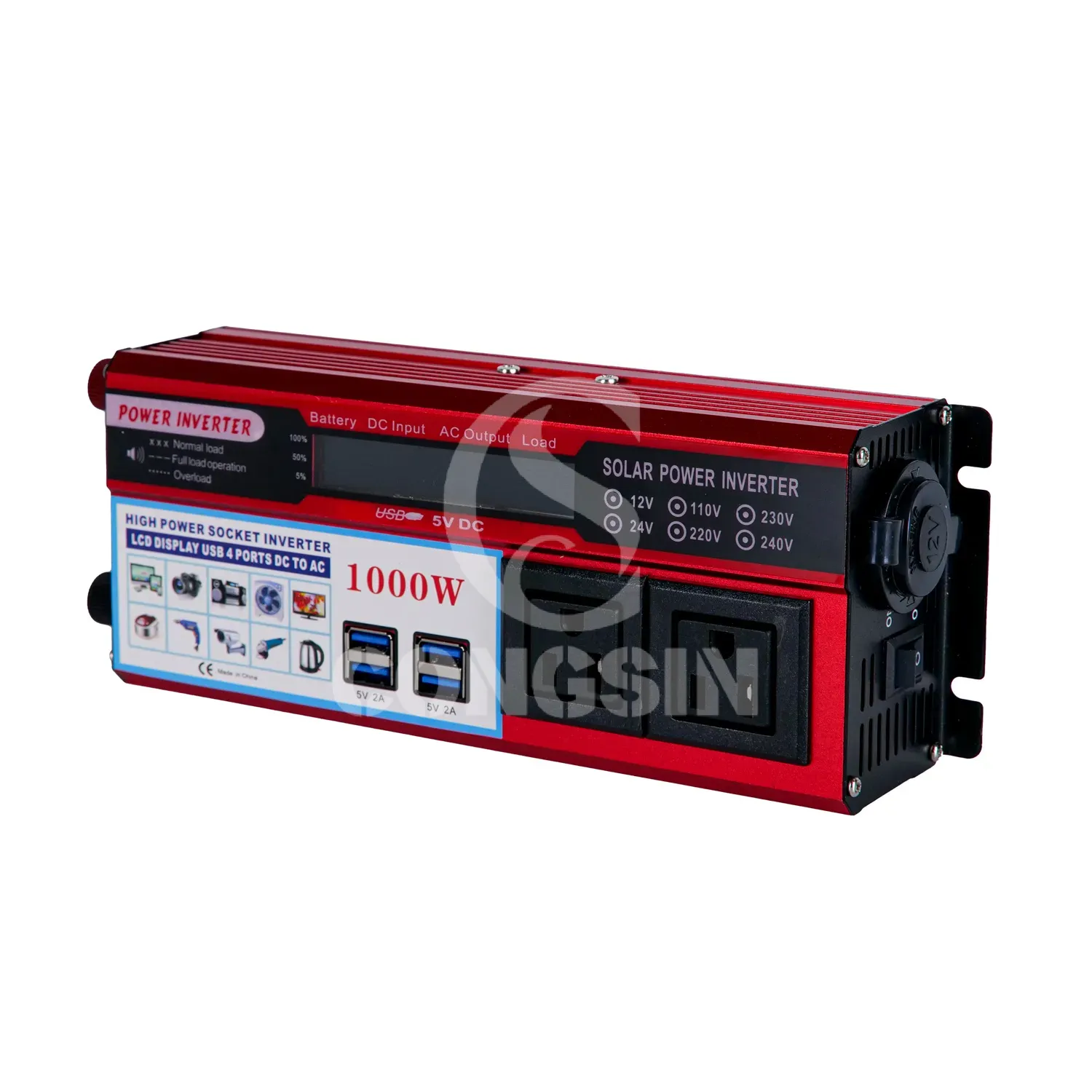
Congsin 1000W modified sine wave inverter with American Sockets and Lcd display portable 12V car RV
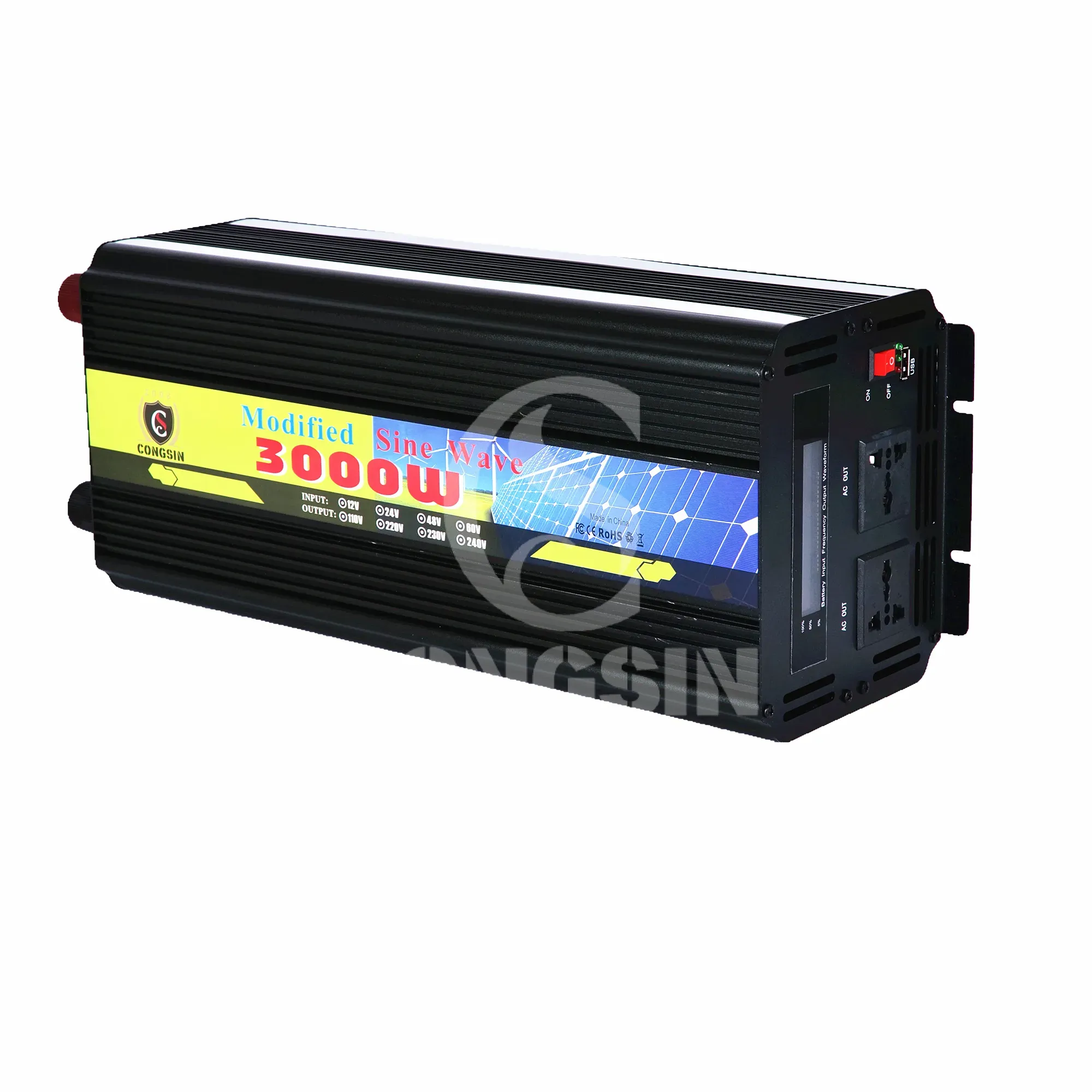
Congsin Full Power 3000W Modified Sine Wave Inverter Peak Power 6000W with LCD Display RV Solar
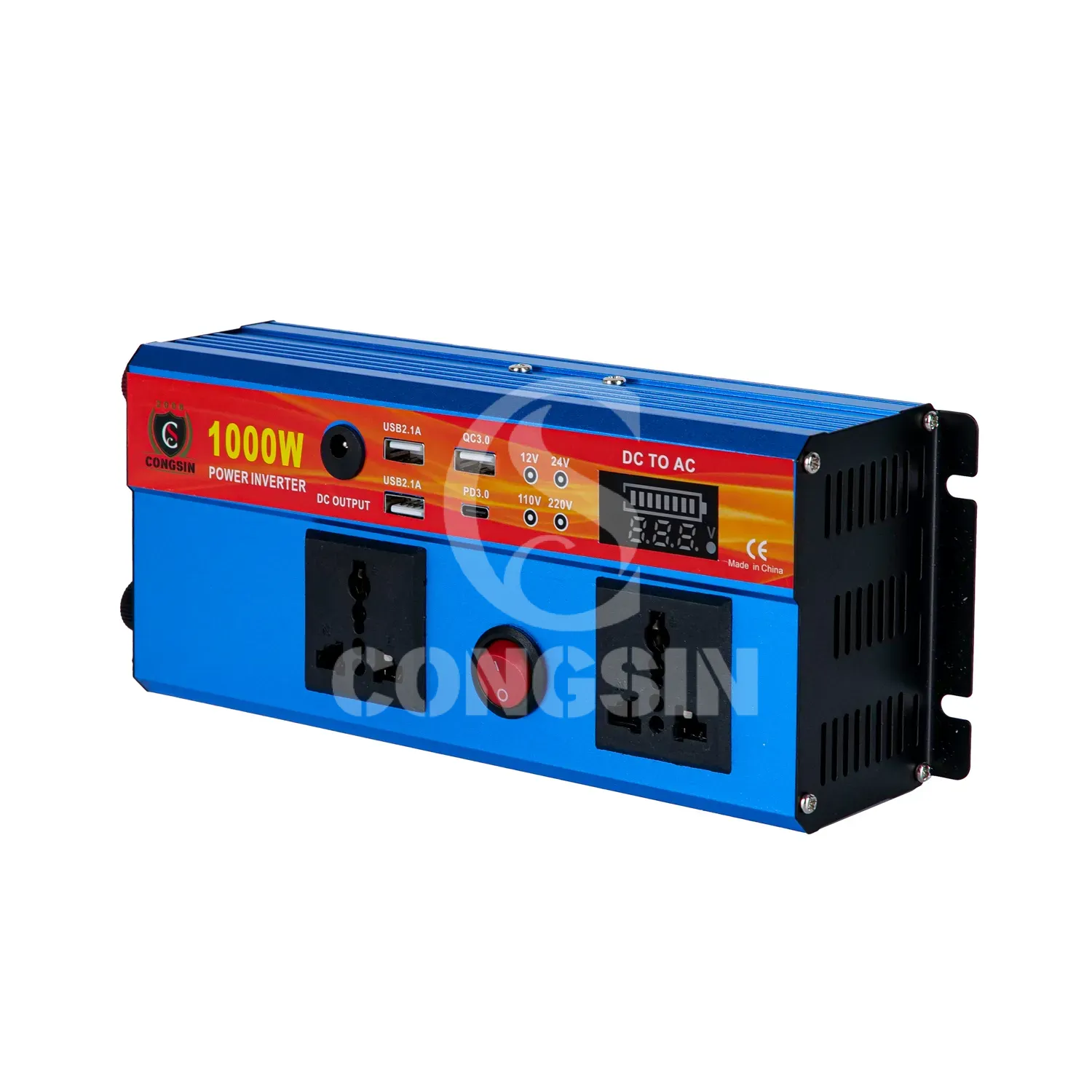
Congsin 1000W modified sine wave inverter with LED display and Type C port car RV power inverter
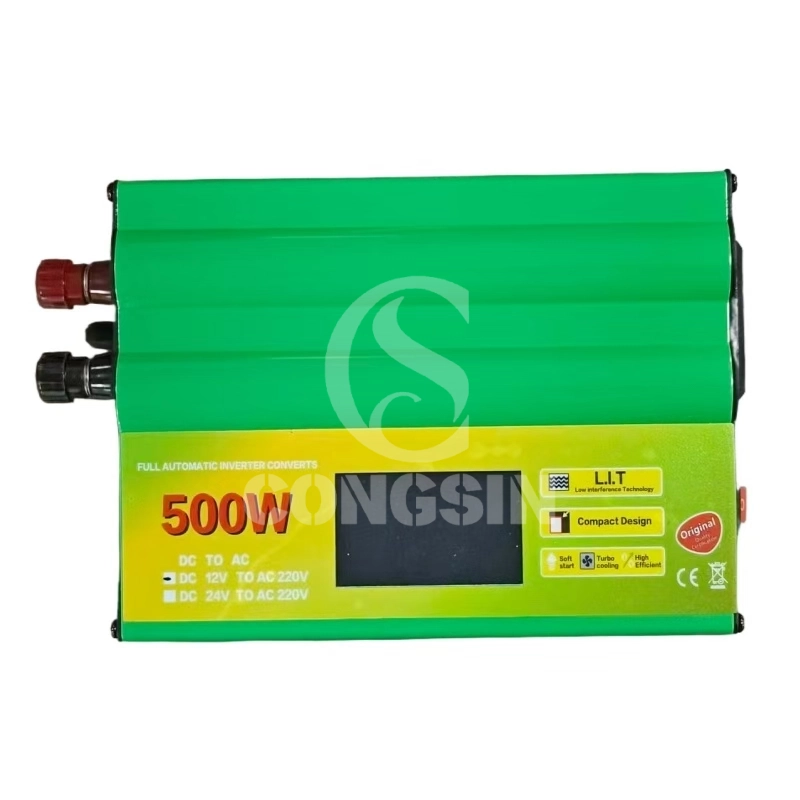
Congsin Modified Sine Wave Inverter 500W 1000W 1500W 12V LED Display Portable for RV Car Solar

CONGSIN is a trusted OEM factory for power inverters, solar charge controllers, and DC converters. Reliable solutions for global B2B buyers.
 High Quality
 7/24 Service
 Guaranteed Warranty
© 2025 Congsin. All Rights Reserved.